Feed Production Line Cost: 2027 Price Guide by Capacity
Home / Feed Production Line Cost: 2027 Price Guide by Capacity
2027 BUYER'S GUIDE
How much does a feed production line cost?
A complete feed production line ranges from about $20,000–$60,000 for a small 1–2 t/h setup to $500,000–$800,000 for a 25–40 t/h plant, with a super-scale 50 t/h line reaching roughly $2–2.6 million. These are indicative equipment-investment ranges, not fixed quotations — the final figure depends on capacity, feed type, process route, automation level and how much auxiliary equipment the project includes. This guide breaks the cost down by capacity so you can set a realistic budget before requesting a configuration-based quote.
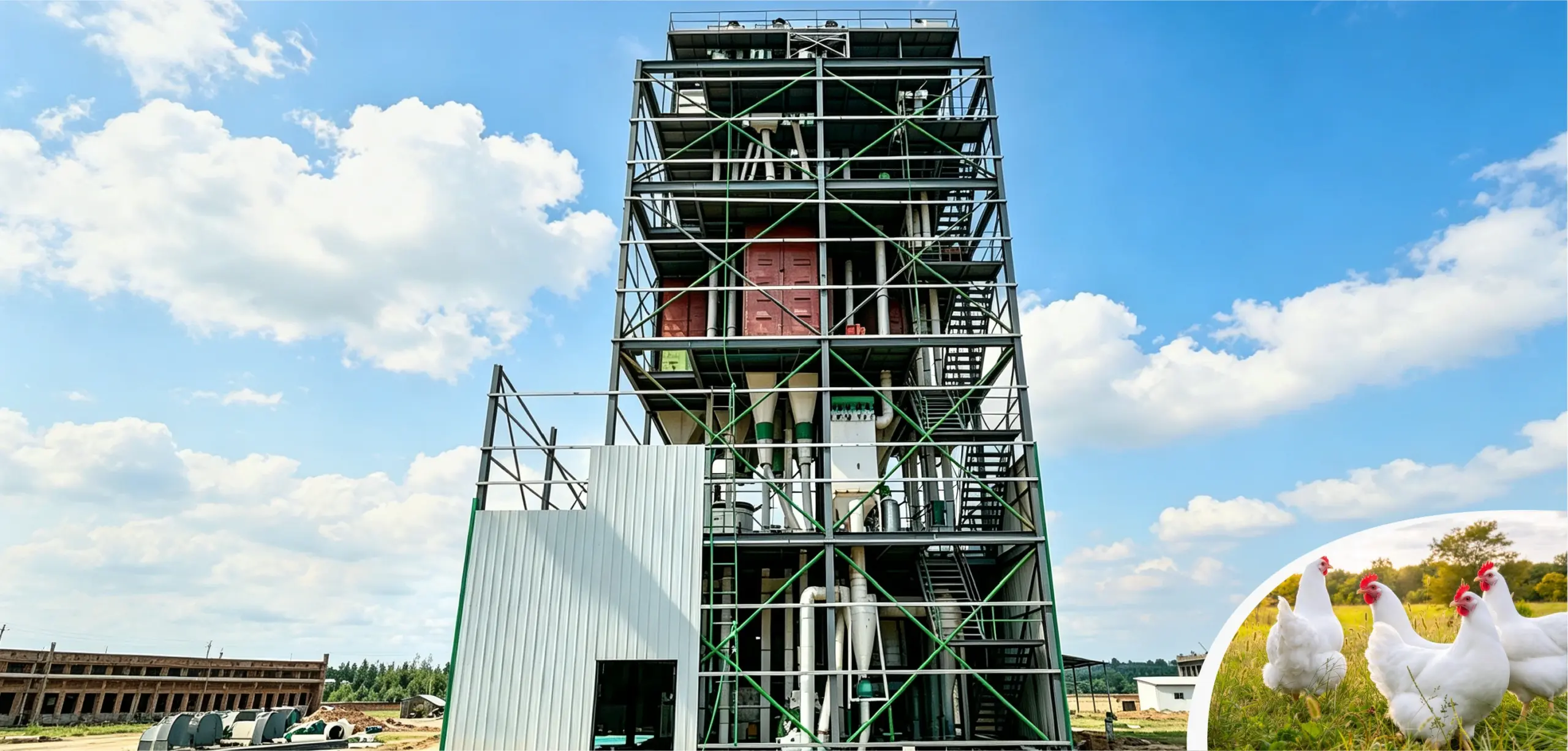
A complete poultry feed pellet line — equipment investment depends on capacity, feed form and automation.
01
Feed Production Line Cost by Capacity
The table below gives the indicative equipment investment, total installed power, approximate site area and lead time for each capacity band. Treat the figures as a starting reference only.
All figures are indicative equipment-investment reference ranges, not a fixed quotation. Freight, duties, civil works and local installation are normally quoted separately.
02
Three Equipment Grades at the Same Capacity: Economy, Standard and High-Configuration
A capacity band is a range, not a single price, because the same output can be built to three equipment grades. Using a 10 t/h line as an example:
OPTION A
Economy
Mash feed or simple single-formula pellet line, manual or semi-auto batching, minimal storage, manual packing
Multiple formulas, fibre-rich raw materials, pre-batching, larger silo capacity, MCC control centre, full automation
$360,000–$450,000
indicative equipment investment
The same logic applies at every capacity. Two suppliers can both quote a "10 t/h line" yet land at very different figures because one priced an economy arrangement and the other a high-configuration plant. When comparing offers, match the equipment grade and process scope first — not just the headline capacity.
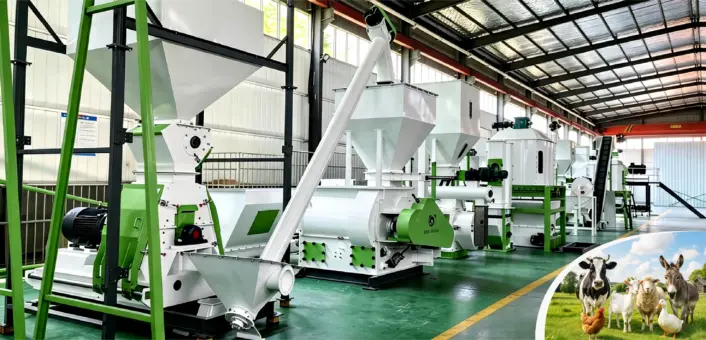
Inside an automatic feed line — grinding, mixing, pelletizing and conveying sections.
03
What Is Included in a Complete Feed Production Line?
A "complete line" means the equipment from raw-material intake to finished-product packing. At minimum it includes: receiving and storage silos, a grinding section (hammer mill or pulverizer), a mixing section, a pelletizing section (pellet mill, conditioner, cooler, crumbler and screen where required), conveying equipment between each stage, and a packaging scale. A fully automatic line also includes a computer-controlled batching system and a central MCC control panel. Because "complete" can mean anything from a few machines to a fully integrated plant, always compare quotations section by section — not by the headline capacity alone.
04
What Is Usually Excluded From the Quotation?
The equipment price normally does not cover ocean freight, import duties and taxes, civil works and foundations, steam or boiler systems, high-voltage transformers and external cabling, on-site installation labour, and start-up spare parts. Working capital for raw materials is also the buyer's responsibility. When budgeting, add a contingency for these items — they are frequently 15–30% of the equipment cost on a large project.
05
5 Factors That Change the Price at the Same Capacity
Two lines with the same rated capacity can differ substantially in price. The main reasons are:
1
Feed form — a mash-feed line needs no pellet mill, cooler or crumbler and costs notably less than a pellet line.
2
Raw material type — fibre-rich materials such as grass, straw or alfalfa need heavier grinding and conditioning equipment than corn/soy-based poultry feed.
3
Process scope — whether the project includes storage silos, pre-batching, a crumbler, fat/oil addition and automatic packing.
4
Automation level — manual batching versus computer-controlled batching with an MCC control centre.
5
Installation and layout — a vertical multi-floor layout, steel structures and long-distance conveying add engineering and installation cost.
06
How Much Does a 3–4 t/h Feed Line Cost?
For the 3–4 t/h budget band, indicative equipment investment is approximately $60,000–$180,000. At this scale the price depends mainly on whether the line produces mash or pellets and on how much automation is included. For example, our SZLH350-based 3–5 t/h line in Myanmar uses a 55 kW main motor with Ø2–10 mm interchangeable pellet dies and a standard single-layer conditioner. Read the 3–4 t/h feed line configuration → for the full equipment list.
INDICATIVE RANGE
$60,000–$180,000
07
How Much Does an 8–10 t/h Feed Line Cost?
An 8–10 t/h complete feed production line has an indicative equipment-investment range of approximately $160,000–$320,000. This should not be read as a fixed price for every 10 t/h plant: a simple poultry-feed pellet line and a line processing fibre-rich materials require quite different equipment. A reference design based on the SZLH420 pellet mill with automatic batching and computer control sits within a narrower band of roughly $250,000–$320,000, while a composite line handling straw/alfalfa can reach $380,000–$420,000. See the 8–10 t/h feed production line → for configuration and layout details.
INDICATIVE RANGE
$160,000–$320,000
08
How Much Does a 12–20 t/h Feed Line Cost?
A 12–20 t/h line has an indicative equipment-investment range of approximately $280,000–$580,000. At this scale, storage, steel structures, electrical systems, conveying capacity and installation become increasingly important parts of the budget. The documented Ethiopia project uses two SZLH420 pellet mills with computer-controlled batching. Final investment depends on the installed equipment and project scope. See the 12–20 t/h feed production line →.
INDICATIVE RANGE
$280,000–$580,000
09
Operating Cost per Ton: Electricity, Labor and Wear Parts
Investment is only part of the picture. The ongoing cost per ton of finished feed is driven by three items: electricity, labour and wear parts (dies, rolls, hammer blades and screens).
Cost item
What drives it
How to reduce it
⚡ Electricity
Grinding and pelletizing are the largest consumers
Match mill power to the real recipe; avoid over-specifying
◉ Labour
Automation level and shift pattern
Automatic batching and packing reduce headcount
⚙ Wear parts
Abrasive raw materials and die compression ratio
Choose die material to the formula; keep spares on site
As a practical reference, a well-configured automatic line at 10 t/h typically needs only a small operating crew per shift, because batching, conveying and packing are automated.
10
Real Projects: What Different Budgets Actually Bought
Published cost ranges are easier to trust when tied to real installations. A selection of LUODATE projects:
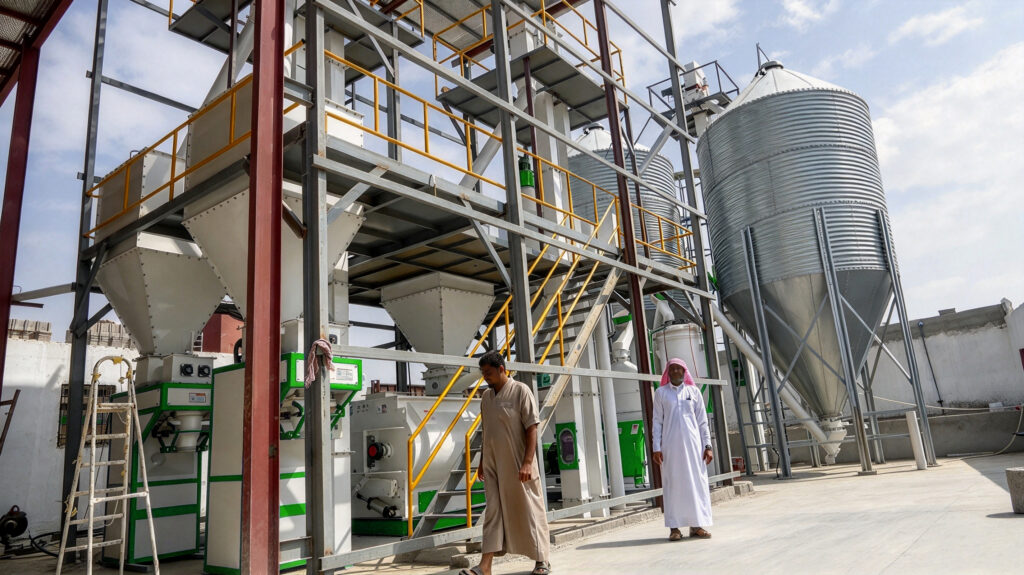
A LUODATE feed line on site with the customer — real installations back up the cost ranges.
Project
Capacity
Configuration
Link
Saudi Arabia mash line
10 T/H
SFSP66×80 hammer mill + SLHSJ2 mixer, 2×100 t silos
These examples show why "capacity" alone is a poor price guide: the same nominal capacity can mean a mash line, a poultry pellet line or a multi-ingredient automatic plant.
11
Frequently Asked Questions
How much does a complete feed production line cost?
A complete line ranges from about $20,000–$60,000 at 1–2 t/h to $500,000–$800,000 at 25–40 t/h; a 50 t/h plant can reach about $2–2.6 million. These are equipment-investment reference ranges. Freight, duties, civil works and installation are normally quoted separately.
How much does a 10 t/h feed production line cost?
An 8–10 t/h line has an indicative equipment-investment range of approximately $160,000–$320,000. The final price depends on feed type, raw materials, process route, automation and included equipment.
Is a pellet mill the same as a complete feed production line?
No. A pellet mill is one machine in the pelletizing section. A complete line also includes storage, grinding, mixing, conveying, cooling, screening and packing. Quoting only the pellet mill underestimates the investment.
Why do two lines with the same capacity cost different amounts?
Because capacity is only one variable. Feed form (mash vs pellet), raw material type, automation level, storage scope and installation requirements all change the equipment list and the price.
What is usually excluded from a feed line quotation?
Typically ocean freight, import duties, civil works and foundations, boiler/steam systems, transformers and external cabling, installation labour and initial spare parts.
How long does delivery and installation take?
For a 10 t/h line, equipment lead time is roughly 30–40 days and on-site installation 45–60 days. Smaller lines are faster; 25–40 t/h projects can take 50–60 days for equipment and 90–120 days for installation.
How much site area does a feed line need?
Approximately 800–2,000 m² for an 8–10 t/h line and 1,500–3,000 m² for 12–20 t/h, depending on layout and storage. A vertical layout reduces footprint.
Can the price be fixed before the recipe is known?
No reliable quotation can be fixed without the formula, target capacity and automation requirements. That is why we quote on configuration, not on a headline tonnage.
1Get A Quote2
Thank you for your interest in LUODATE Machinery. If you want to learn more about our Feed Machine and Biomass Machine, Contact us Now to find out what we can do for you next project !